
Lock Glossary for Boston Homes
The words a locksmith uses for the parts of a lock, a key and a door, each in plain English with where to find it on your own door.
Lock and Key Terms in Plain Words
Most of the difficulty in describing a lock comes from not knowing what its parts are called. A cylinder, a latch and a strike plate sit on nearly every front door in Boston, yet few people have reason to name them until something goes wrong with one.
Some of these words describe parts you can see and touch, like the latch and the strike plate. Others, like the keyway and rekeying, describe what happens inside the lock, where only the key ever goes.
Find a Term
Type a word, or choose a letter or a topic, then press the button.
| Term | Plain-words meaning | Where you will see it on your door |
|---|---|---|
| Backset | The distance from the edge of the door to the center of the lock’s hole. Residential locks usually come in 2-3/8 or 2-3/4 inches, and a new lock has to match the door’s backset to fit its holes. | Measured across the face of the door, from the edge to the middle of the keyhole. |
| Cylinder | The part the key goes into: a round plug holding a row of small pins that the right key lines up so the plug can turn. A rekey changes those pins and leaves the rest of the lock alone. | The round face with the keyhole, on the outside of a deadbolt or in the middle of a knob. |
| Deadbolt | A lock with a solid, square-ended bolt that slides into the frame and stays there until a key or a thumb turn draws it back. Unlike a latch, it cannot be pushed back from the edge of the door, so an outside door without one is worth a new deadbolt. | A round lock above the handle, with a keyhole outside and a thumb turn inside. |
| Handleset | An entry set with a long outside grip and a thumb latch, usually paired with a deadbolt above it and a knob or lever inside. Fitting one takes an extra hole through the door for the grip’s lower screw. | On front doors: a tall handle outside, with a thumb press over the grip. |
| Key blank | An uncut key shaped to fit one keyway, ready to be cut to match an existing key. A key copy starts as a blank and is best cut from a good original rather than a worn one. | Not on the door at all: it is what a spare key starts as. |
| Keyway | The shaped slot in the cylinder that the key slides into. Its profile decides which blanks fit, so two locks can take one key only when their keyways match. Restricted keyways have blanks controlled by the key’s maker, which limits where copies can be cut. | The keyhole itself, seen face on: the grooves along its sides are the keyway’s shape. |
| Latch | The angled, spring-loaded bolt that clicks into the frame when the door closes and holds it shut until the handle draws it back. A latch that no longer catches needs a lock repair, or a door brought back into line. | On the edge of the door, level with the knob or lever. |
| Master key | A key that opens a whole group of locks, each of which also has its own key. It is set up inside the cylinders as a master key system, mostly for businesses and larger buildings. | Nowhere obvious: the locks look ordinary, and the difference is inside the cylinders. |
| Mortise lock | A lock whose body sits in a deep pocket cut into the edge of the door, often with the latch and the deadbolt in one case. Older front doors and many commercial doors have them, and a worn one is often worth repairing rather than replacing. | A tall faceplate on the edge of the door, often with the keyhole under the knob. |
| Rekey | To change the pins inside a cylinder so a new key works and the old keys stop working, while the lock itself stays on the door. Rekeying suits a move or a lost key; it cannot fix a worn or broken lock. | Nowhere you can see: the lock looks the same afterward, and only the key is different. |
| Smart lock | A lock that opens with a code, a phone or both, usually with a key cylinder as a backup. It runs on batteries, and its code is only as safe as the people who know it. Keypad and smart locks are fitted much like a deadbolt. | A deadbolt with a keypad or a plain outside face, and a larger housing inside for the batteries. |
| Strike plate | The metal plate screwed to the door frame, with an opening that the latch or the bolt slides into. Fixed with long screws, it makes the door far harder to force; out of line, it is often why a deadbolt sticks. | On the frame, facing the edge of the door, one plate for each bolt. |
Naming the Parts of Your Own Door
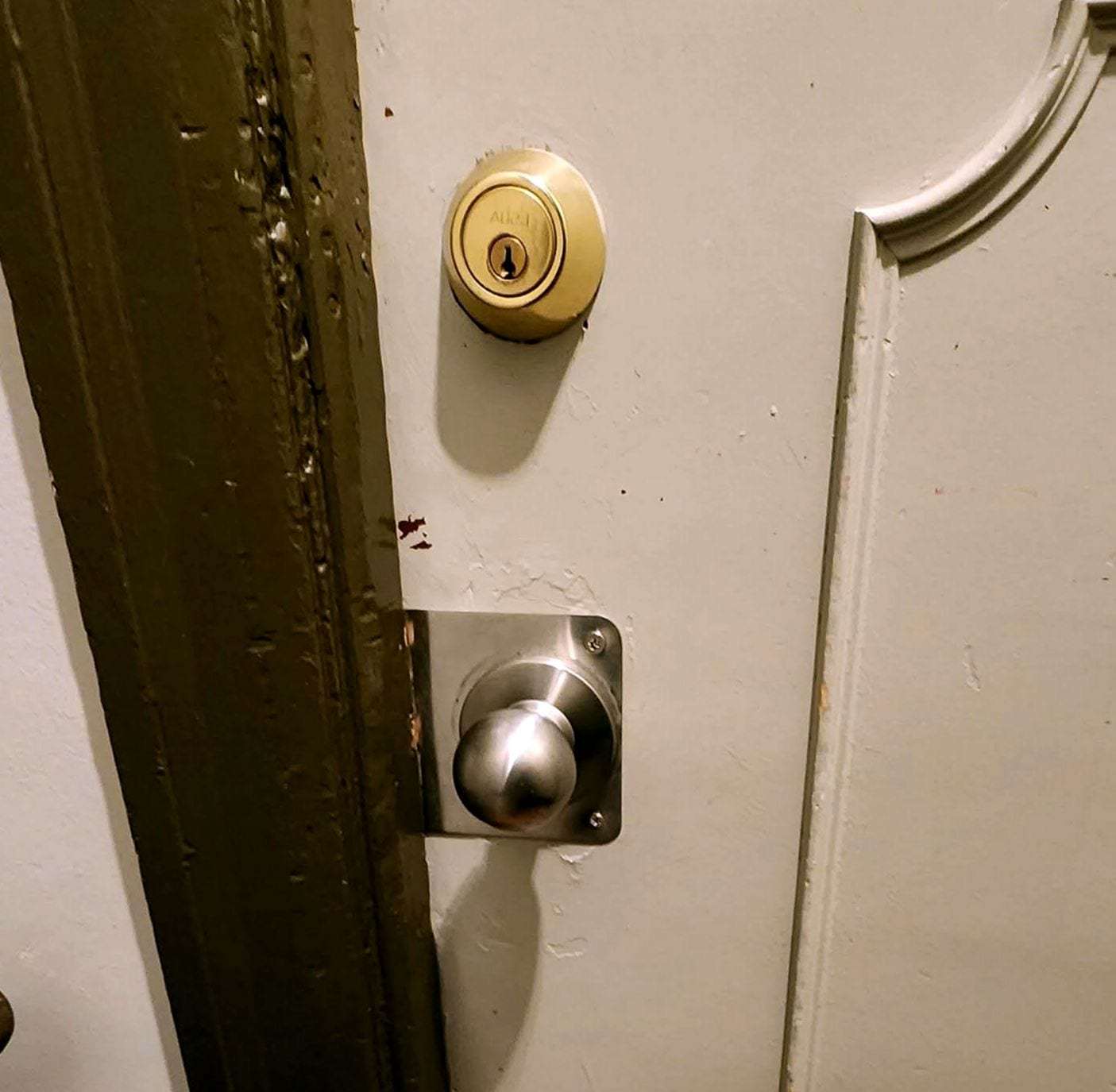
Open your front door and look at its edge first. The angled piece level with the knob is the latch; the square-ended bolt above it, if there is one, belongs to the deadbolt. Each sits in a faceplate screwed into the edge, and a single tall faceplate holding both usually means a mortise lock.
Across from them, on the frame, are the strike plates the latch and the bolt slide into. Then step outside and look at the face of the door: the knob, lever or handleset you hold, and the round face of the cylinder where the key goes in. Inside, the deadbolt usually has a thumb turn in place of a keyhole.
The one measurement worth taking is the backset, from the edge of the door to the center of the keyhole. Written down with the thickness of the door, it tells a locksmith whether a new lock will fit the holes already there.
Words That Help on the Phone
A few plain words describe most doors well enough to start with. “A brass deadbolt above a knob” and “an old lock with the keyhole under the knob” paint very different pictures, and the second points to a mortise lock before anyone has seen it.
It also helps to say which door it is: a front door onto the street, a back door off a kitchen, a door in a building’s common hall, or the door of a shop. Each tends to carry its own kind of hardware, and the name of the door often says as much as the name of the lock.
The right words are never required, though. A name for the part is only half the picture; the other half is the trouble itself, and each of the usual signs of lock trouble points to a likely cause.
When the Right Word Will Not Come
Call and describe the door in your own words; nobody needs the proper term to get help with a lock.